Volume 15, Number 4Photograph taken
11 October 1968
One year after diagnosis.
An ordinary fishing photograph, printed for a ten-dollar contributor fee, that became one of the earliest surviving public records of a life now in its sixtieth year with Type 1 diabetes.
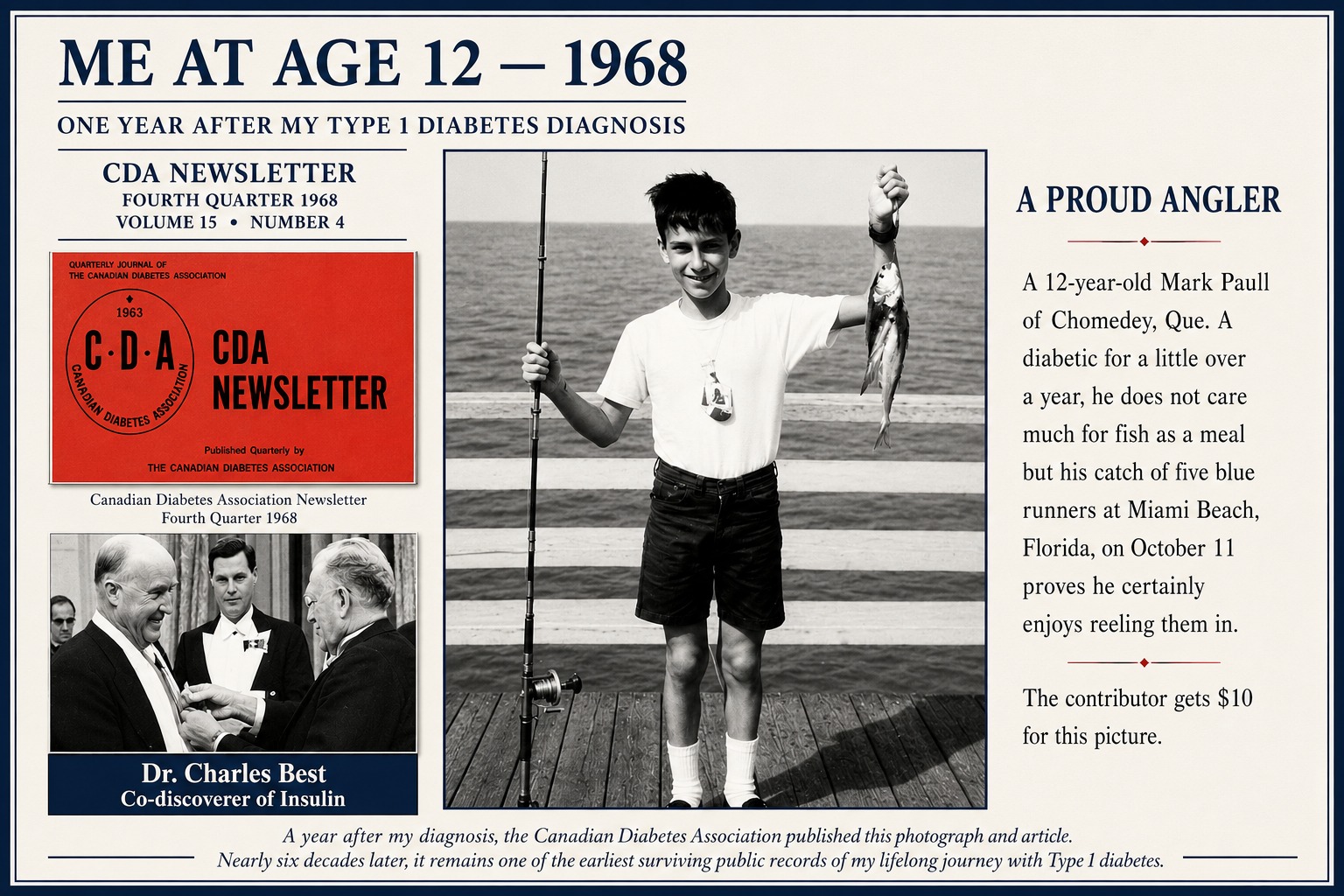
The caption ran under the heading A Proud Angler. It reported that a twelve-year-old from Chomedey, Québec — diabetic for a little over a year — did not care much for fish as a meal, but that his catch of five blue runners at Miami Beach proved he certainly enjoyed reeling them in. The contributor was paid ten dollars for the picture.
The importance now is not the fishing. It is continuity. Dr. Charles Best, co-discoverer of insulin, appeared in the same issue. The two images sit inside one publication: the discovery that made survival possible, and a child at the beginning of a life shaped by it.
In 1968 there were no home blood glucose meters, no continuous monitors and no automated insulin delivery. Management depended on urine testing, reusable equipment, experience and judgment — which is to say it depended almost entirely on the layer no one was recording.
The photograph is a hinge for Come On, Marky: a visible boy at the start of a largely invisible lifetime of decisions. The boy in it had already been keeping the other record for a year, and no one had asked to see it.
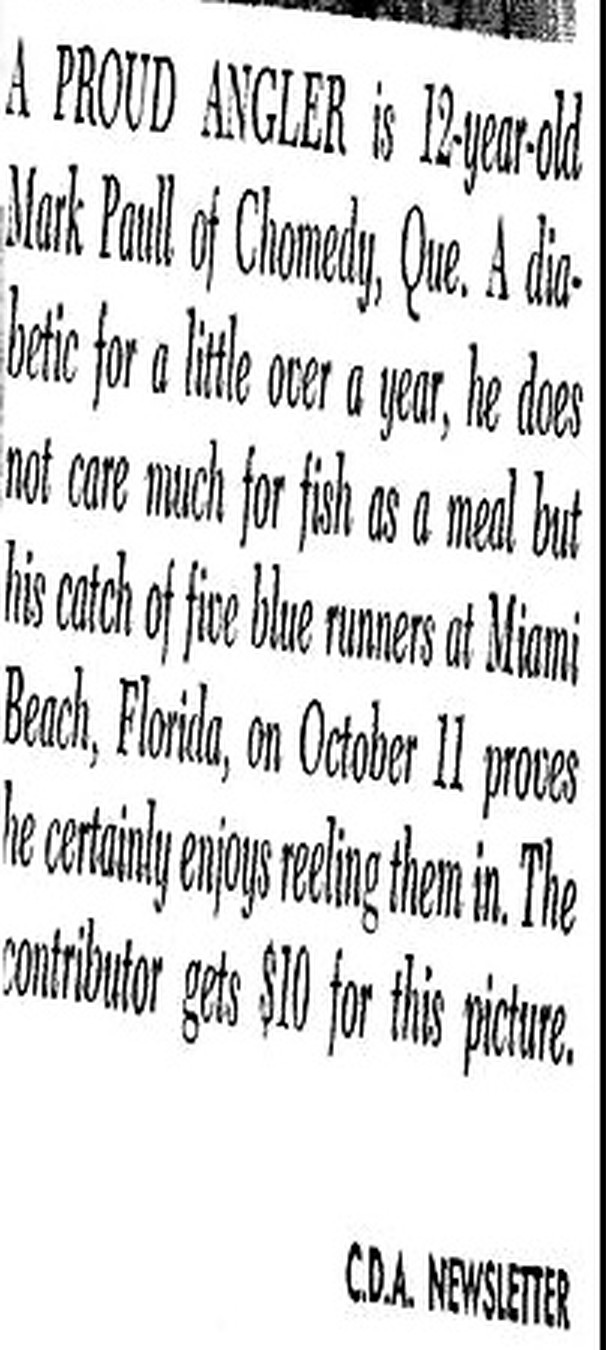
A proud angler is 12-year-old Mark Paull of Chomedy, Que. A diabetic for a little over a year, he does not care much for fish as a meal but his catch of five blue runners at Miami Beach, Florida, on October 11 proves he certainly enjoys reeling them in. The contributor gets $10 for this picture.
Forty-nine words, and the disease arrives in the second sentence — before the fish, before the boy's name has finished settling. The town is misspelled. That ordering is the book's subject in miniature.
The original notebooks from these years were destroyed in a flood. This page is among the few pieces of paper from 1968 that survived.